The Equations of Everything That Flows

Fluids are everywhere. Air rushes past airplane wings, rivers bend and twist through valleys, smoke curls lazily from a candle, and blood flows through our veins. These are all examples of matter in motion—continuous, smooth, impossible to pin down to just a handful of particles.
A natural question arises: how do we capture all this motion with mathematics? How do we write down equations that explain the swirl of cream in coffee or the gust of wind at your window?
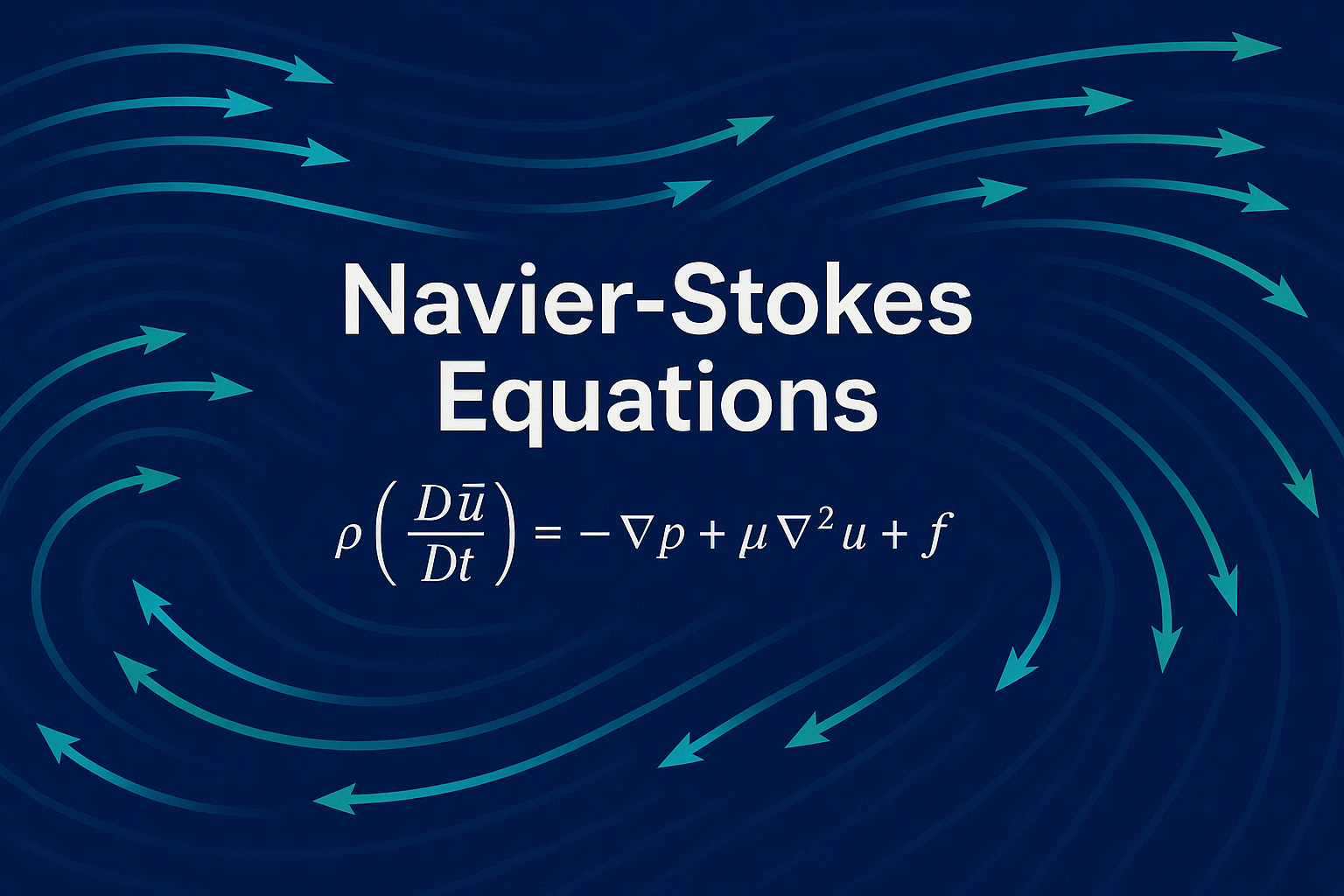
The answer lies in the Navier–Stokes equations. They are, in essence, Newton’s second law applied not to a single particle, but to a fluid—a continuous field of mass and motion. They are short enough to fit on a mug, yet so complex they have kept mathematicians and physicists awake at night for two centuries. In fact, a one-million-dollar prize awaits anyone who can resolve their deepest mysteries.
The Core Idea: Playground Physics
Before diving into the math, let’s strip things down to four simple ideas you might explain on a playground:
1. Stuff Doesn't Vanish (Mass Conservation): Picture a bucket of toy balls. If you scoop some out, the bucket has fewer. If you pour more in, it has more. Balls don’t appear or vanish on their own. Fluids are the same: they just move around.
2. Things in Motion Stay in Motion (Momentum Conservation): Push water in a swimming pool. It pushes back and keeps moving even after you stop. This is Newton's second law: an object's momentum changes only when a force is applied.
3. Stickiness (Viscosity): Stirring water is easy; stirring honey is hard. Honey resists motion more than water does. That resistance—that internal friction—is viscosity.
4. Pushing (Pressure): Dive deep underwater and feel your ears pop. That’s pressure: the fluid pushing on you from all directions.
These four principles are the heart of the Navier-Stokes equations. The math is just a precise language to describe them.
A Brief History: From Ideal to Reality
Our story begins in the 18th century with Leonhard Euler. He wrote down equations for an "ideal fluid"—a substance with no friction or "stickiness." In Euler’s world, fluids would glide effortlessly forever. His equations were elegant, but they didn't quite match reality. Real fluids, like honey or even water, resist motion.
It took nearly a century to bridge that gap. In 1822, Claude-Louis Navier began adding the effects of internal friction, imagining fluids as tiny interacting molecules. Two decades later, George Gabriel Stokes refined this idea, giving us the final, rigorous form of the equations that are now the foundation of fluid dynamics.
The Language of Fluids: A Dash of Vector Calculus
To write our playground rules in the language of math, we need a few tools from vector calculus. First, we must assume a continuum—that we can treat the fluid as a smooth, continuous substance rather than a collection of individual molecules. This allows us to describe properties like pressure and velocity at every single point in space.
With that, we only need one key operator, Nabla (∇), a vector of partial derivative operators that helps us measure how things change in space.
\[ \nabla = \left( \frac{\partial\phi}{\partial x}, \frac{\partial}{\partial y}, \frac{\partial}{\partial z} \right) \]
From it, we build three essential concepts:
- Gradient (∇ϕ): For a scalar field (like temperature or pressure), the gradient is a vector that points in the direction where that value increases the fastest. The pressure force in a fluid, for example, is driven by the pressure gradient, -∇p, which pushes the fluid from high pressure to low.
\[ \nabla\phi = \left( \frac{\partial\phi}{\partial x}, \frac{\partial\phi}{\partial y}, \frac{\partial\phi}{\partial z} \right) \]
- Divergence (∇⋅u): For a vector field (like velocity \( u \) ), divergence measures how much the field is "spreading out" from a point. In an incompressible fluid like water, the velocity divergence is zero (∇⋅u=0), meaning the fluid isn't expanding or compressing.
\[ \nabla \cdot \mathbf{u} = \frac{\partial u_x}{\partial x} + \frac{\partial u_y}{\partial y} + \frac{\partial u_z}{\partial z} \]
- Curl (∇×u): The curl measures the local rotation or "swirl" in a vector field. For a fluid, the curl of the velocity field is known as vorticity—it tells us how much a tiny paddlewheel would spin at that point.
\[ \nabla \times \mathbf{u} = \left( \frac{\partial u_z}{\partial y} - \frac{\partial u_y}{\partial z} \right)\mathbf{i} + \left( \frac{\partial u_x}{\partial z} - \frac{\partial u_z}{\partial x} \right)\mathbf{j} + \left( \frac{\partial u_y}{\partial x} - \frac{\partial u_x}{\partial y} \right)\mathbf{k} \]
The Equations Themselves
Armed with these tools, we can finally write down the Navier-Stokes equations for an incompressible fluid (like water or air at low speeds).
1. The Continuity Equation (Mass Conservation)
This equation says that stuff doesn't vanish. For an incompressible fluid, it's beautifully simple:
\[ \nabla \cdot \mathbf{u} = 0 \]
This states that the divergence of the velocity field is zero. Fluid isn't created or destroyed at any point; what flows in must flow out.
2. The Momentum Equation (Newton's Second Law)
This is the main event. It's a force-balance equation that says mass × acceleration = sum of forces.
\[ \rho\left(\frac{\partial \mathbf{u}}{\partial t} + (\mathbf{u} \cdot \nabla)\mathbf{u}\right) = -\nabla p + \mu\nabla^2\mathbf{u} + \mathbf{f} \]
Let's break that down:
- \( \rho (...) \) is the
mass × accelerationpart.- \( \rho \) is the fluid's density (mass per volume).
- \( \frac{\partial \mathbf{u}}{\partial t} \) is the local acceleration: how the velocity at a fixed point changes over time.
- \( \left(\mathbf{u} \times \nabla\right)\mathbf{u} \) is the convective acceleration: the change in velocity an object feels simply by moving to a different part of the flow. This is the term that makes everything so difficult.
- \( -\nabla \mathbf{p} + \mu \nabla^{2}\mathbf{u} + \mathbf{f} \) is the
sum of forcespart.- \( -\nabla \mathbf{p} \) is the pressure force, pushing the fluid from high to low pressure.
- \( \mu \nabla^{2}\mathbf{u} \) is the viscous force—the mathematical form of "stickiness." \( \mu \) is the viscosity. This term resists motion and smooths out the flow.
- \( \mathbf{f} \) represents any other external forces, like gravity.
Why They’re So Hard: The Chaos of Turbulence
At first glance, the equations look manageable. But a trap lurks in the convective acceleration term,(u⋅∇)u. Here, the velocity u is influencing its own acceleration. The flow feeds back on itself.
Think of a microphone placed too close to a speaker. The sound from the speaker is picked up by the microphone, amplified, and sent back to the speaker, creating a chaotic, unpredictable feedback loop.
This feedback is what creates turbulence—the chaotic, swirling, unpredictable motion we see in smoke, waterfalls, and stormy skies. This non-linear behavior makes the equations almost impossible to solve exactly for most real-world situations. We don't even know if smooth, well-behaved solutions are guaranteed to exist in three dimensions. Proving they do is the million-dollar Clay Millennium Problem.
How We Solve Them: The Rise of CFD
If we can't solve the equations by hand, how do we use them? For very simple cases, like smooth flow in a straight pipe, we can find exact analytical solutions. But for anything complex, we turn to computers.
This is the field of Computational Fluid Dynamics (CFD).
CFD works by breaking down a physical space (like the air around a car or a plane) into a grid of millions of tiny cells. A powerful computer then solves an approximate version of the Navier-Stokes equations for each individual cell, step by step through time. This process builds a detailed picture of how the fluid moves, allowing us to:
- Design more aerodynamic cars and aircraft.
- Predict weather patterns and ocean currents.
- Simulate the flow of blood through human arteries.
While CFD provides invaluable approximations, it doesn't give us the perfect, general solution that mathematicians are still searching for.
Why They Matter
Despite the mathematical challenge, the Navier-Stokes equations work astonishingly well. They are the universal grammar of fluids, describing an enormous range of phenomena that are central to science and engineering. From the weather forecast you check in the morning to the design of the plane you fly in, these equations are silently at work, describing the beautiful and complex dance of everything that flows.
Further Reading
- L. D. Landau & E. M. Lifshitz — Fluid Mechanics
- P. A. Davidson — Turbulence: An Introduction for Scientists and Engineers
- Uriel Frisch — Turbulence: The Legacy of A. N. Kolmogorov